
On Bread and Counsel
On deferring your cravings for quick gratification, in service of something more nourishing
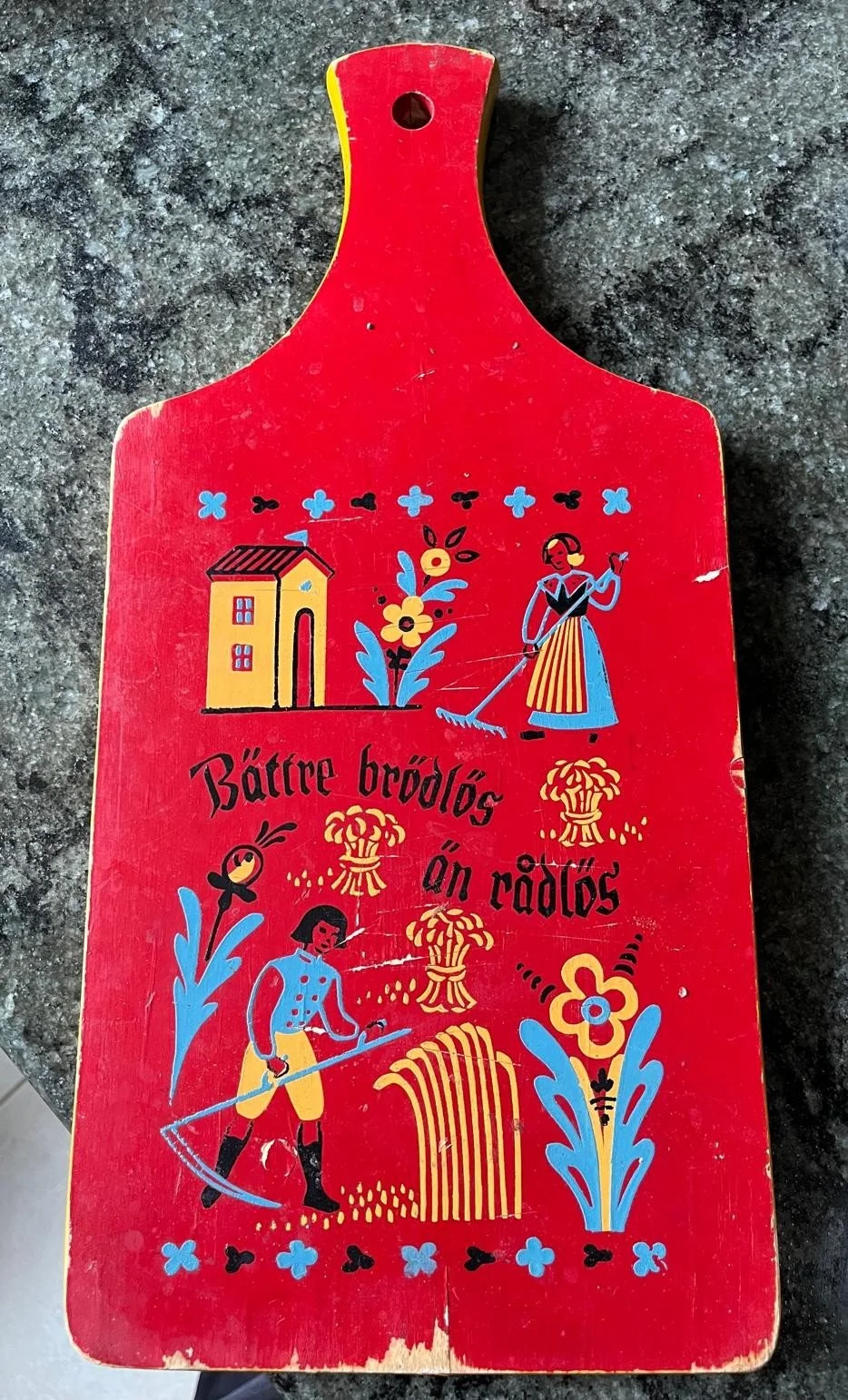
If you’re Swedish (or are one of the 10 million people in the world who speak Swedish) this saying might mean something to you: “Bättre brödlös än rådlös.” If you aren’t, and especially if you haven’t got a clue how to even begin to pronounce it, let me enlighten you.
First, the back story: this breadboard hung on the kitchen wall of my childhood home. I never knew anything about its origin, where my mom got it, what the saying meant. It was just decor.
When my mother died last year and me and my siblings sorted through what household treasures we wanted to keep, this one called to me. Part of it was that our mother was a prolific breadbaker, and this was a reminder of the constant supply of homemade bread we had in our home. I tucked it away in my shipment, forgot about it for a year, and was happy when I pulled it out this summer and hung it on my kitchen wall – a reminder of mom and of the warm home she created. I found myself wondering where and why she got it; what it meant to her. And also – what language is this, and what does it say??
So I took a photo, fed it to Claude, and asked for more information. I learned from Claude that this is a Swedish folk-style cutting/ breadboard, likely from the 1940s or 50s, and that the saying,"Bättre brödlös än rådlös," is a Swedish proverb that literally means "Better without bread than without counsel." Now that I knew it was Swedish, I checked with my Swedish friend Bengt Rosberg. He had never seen anything like this breadboard, nor heard the proverb, and his interpretation of the Swedish was slightly different: “Better without bread than without a plan.” So – a couple of different ways to understand the literal Swedish. Then comes the illustration. I see a couple of hard-working farmers raking the soil and tilling the fields. You know – the kind of effort it takes to nurture the conditions so that the loaf of bread gets made in the first place.
So where am I going with all this, besides random musings on a Swedish breadboard. So many ways to take this proverb and apply it to our daily lives and leadership. Here are options that occur to me, spurred by consultation with Bengt and his other wise half, Diana:
- It's better to go hungry (‘breadless’) than to be without a plan, because bread (or it’s metaphorical equivalent) will only serve you for a short time, whereas a plan provides longer term options.
- It’s better to go ‘hungry,’ i.e. not simply ‘eat the bread’ that will make us feel better or give us a spurt of energy momentarily, than to be without counsel, with counsel implying advice, support, good judgment – all of which are worth delaying that quick hit of gratification or dopamine for, and which make us feel less alone. (Ok, Ok, I’ll admit I like this one best because, well, Sidecar Counsel).
- It’s better to go ‘hungry,’ i.e. not immediately sate our cravings (for bread or instant gratification), than to neglect the effort, resources, and creativity required to create the bread in the first place.
I think this latter interpretation is an important message in the age of AI. It’s so easy to go straight to the ‘bread’ – the quick and filling content served up by Claude and cousins – and forego the creativity and resourcefulness, and yes, effort that tasks (like creating conditions for wheat to grow) have traditionally taken. I realize I could come across as a hypocrite here, since Claude did do some of the research that led to my understanding of this wise breadboard. I supplemented it with additional wise counsel, though. And the distinction I’ll make here is this: whether to use AI depends on the ‘bread’ you’re hoping to produce. If it’s a question you’d formerly search on Google (search engines are all pretty much running on AI anyway these days), or a task you might put to an excellent research assistant, with you taking their results and crafting into a ‘loaf’ with your own additional ingredients and bread-baking skills - then, great, go for it. If, on the other hand, it’s simply a shortcut to a finished ‘loaf’ that bypasses your own creativity, involves no counsel (yours or others), effort or resourcefulness, then this becomes a harbinger of future paltry harvests. Because the soil hasn’t been nurtured, and we’ve forgotten how to rake or scythe.
So next time you find yourself hungry, whether for instant gratification of a craving, desire to get an answer quickly, or heck, sheer laziness, ask yourself whether you might be better off going ‘breadless,’ at least for a little while, so you can consider the longer-term implications of giving in.
Yours in choosing the rake over the easy loaf,
Bridget
P.S. A few upcoming offerings aimed at nurturing your creativity and resourcefulness while also offering counsel, and maybe even some real bread:
· Woman Transformers – Dorchess de Koning of Awe Academy and I are co-facilitating Woman Transformers , a 3-webinar series for women whose bodies are transforming (peri/menopause), who want to: 1) understand these changes; 2) do something to ameliorate the particularly rough parts, and 3) get to know their bodies as friends and guides in life and leadership rather than as antagonists. Find out more and register here.
· The Clearing – Alongside Dr. Amanda Sunderman (AIS Vilnius) and Rachael Thrash (Big Bad Boo), I’m co-facilitating this gathering for women leaders heading to the AAIE conference in early February. This 2-night gathering in the mountains north of Atlanta (January 28-30, 2027) is a chance to exhale, gather with other women reshaping what leadership in schools looks like, and arrive at the AAIE conference refreshed and with a community of support at your side. Nine spots still available. Claim yours now.
· Sidecar Summit Vietnam 2027: “What’s The Story?” – I’ve lured the wondrous LeeAnne Lavender to co-facilitate this Summit with me, at the Namia River Retreat in Hoi An from March 5-8, 2027. Join us to get better at storytelling, both the stories we tell ourselves about ourselves and those we tell our school communities in ways that open up whole new possibilities. Early bird registration deadline is December 1; save your seat and $200
