
On Being Boss-y

Let’s re-frame what bossy means for women in leadership.
My last Sidecar Story, on the steep price of ‘nice,’ elicited quite some feedback – much of it nods of recognition, some from women who couldn’t relate, who’d always felt fine about claiming their space and standing up for themselves. And then there were my sisters, who issued important corrections to the story’s initial narrative.
It seems that, as a young girl, I wasn’t as nice as my (admittedly fuzzy) memory suggests.
This piece of evidence showed up as I’ve been unpacking my worldly possessions.
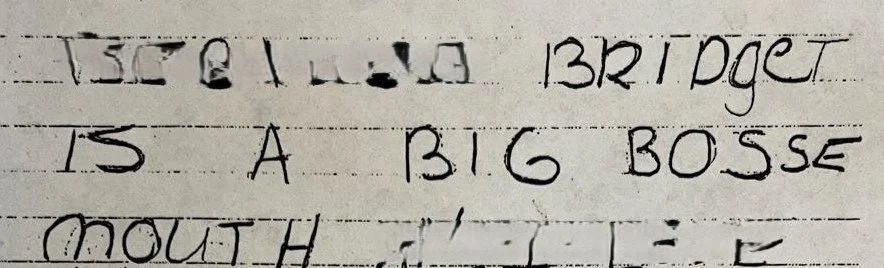
It’s a snippet of a longer lament written by my younger sister Amy to our parents, around the time that we rearranged our bedrooms in our childhood home. I was now in a corner room, boxed in on either side by Amy’s room and Sarah’s room. This meant that I didn’t have my own door. I had to go through one of my sister’s rooms to get into mine, which I often point to as the foundation of my diplomatic skills. Amy would beg to differ. Her complaint to our parents goes on to explain that I ‘threw balls’ at her (must have been when she threatened to barricade me in my room!), and when she got hurt, I just said ‘Ha-Ha.’
How does this square with the ‘Bridget is Nice’ needlepoint masterpiece I showed in the last Sidecar Story? Well, after sending out that post, I learned from my older sister Sarah that there’s a cunning backstory here. Turns out it was she, not me, who created that sweet piece of art (told you my memory is fuzzy!). She had done it in honor of my 9th birthday. Her original intent was to write “Bridget is Nine.” And then when she got to the ‘nine’ part she had a stroke of inspiration: she could change the ‘nine’ to ‘nice’ – the biggest compliment she could imagine for me as I turned nine.
Or perhaps, at some subliminal level, it was her way of nudging me from my ‘bosse mouth’ tendencies to something more acceptable for females in this world. After all, she is older than me, and with that additional lived experience she has learned a thing or two about how to navigate this world as a female. (Indeed, I’ve looked to her for mentorship throughout my life. And I can tell you, she has turned out to be a boss, in all the most admirable ways!)
Whatever the motivation, the sentiment worked its spell on me, and I stand by everything else that appeared in that story about me being nice. I’m glad to know, though, that somewhere in my youth, I had a reputation as a ‘bosse mouth,’ which I intend to take this way: I claimed my space and stood up for myself when things weren’t going my way. (I thoroughly deny any ball throwing, and especially ball throwing that may have hurt someone. My throwing skills have always sucked!)
Bossy – the grown-up way of saying ‘bosse mouth’- is a term associated more with women than men in workplace settings. There’s a whole world of literature out there about the term ‘bossy’ and its application in the world of leadership, especially from a gendered perspective, and not always flattering. For my purposes I’m going to define ‘bossy’ as exhibiting leadership traits like assertiveness, independence, and decisiveness, and behavioural attributes like claiming one’s space and standing up for oneself. When those traits and attributes are associated with male leaders, this is usually simply called ‘leadership.’ However, when they show up in female leaders, it’s not unusual to hear ‘bossy,’ and not necessarily in a complimentary way. This is what is called the ‘double-bind’ for women in leadership: Women are still expected to exhibit stereotypical female traits, e.g. nice, nurturing, altruistic) in leadership roles, yet doing so can also mean they are taken less seriously than men who display stereotypically masculine traits, e.g. assertive, independent, decisive ... bossy!). Yet when women display these same traits, they are seen as unfeminine, mean and unlikeable. And this has ramifications for their promotions into leadership roles.
This needs to change for our workplaces, and their leaders, to thrive. We need to make OK, and model, the range of ways leaders of any gender can lead (I know plenty of male leaders who are way closer to the nice end of the spectrum than the bossy one, yet feel pressure to ‘man up.’) I don’t advocate for the kind of bossy that involves throwing balls or demonstrating any other kind of bullying or domineering behavior. But when bossy means ‘acting like a boss,’ aka a person in charge, well – there’s a wide scope of acceptable behaviors and traits that can serve a leader, and her/ his/ their constituencies, very well.
I’ll still say that, if you ever find yourself in a situation where you are literally ‘cornered’ in a room whose only way out is through potentially hostile territory, then sharpen up that ‘bosse mouth’ and have some balls on hand. And learn how to throw them!
Yours in claiming our space and standing up for ourselves,
Bridget
P.S. Before you head off for summer break, a reminder that two Sidecar Summits are scheduled for this Fall, both chances to fully express your leadership traits, whether nice, bossy, or somewhere in between.
Sidecar Summit Canada’s early bird registration deadline is fast approaching: June 15. Blue Mountains of Ontario, October 15-18, with the theme of ‘Abundance as Resistance.’
Sidecar Summit Portugal is more than half full. Still 7 spots available as of this writing. Ribatejo Valley, November 20-24, with the theme of ‘Vital Leadership.’
Find out more about each and register your interest here.
